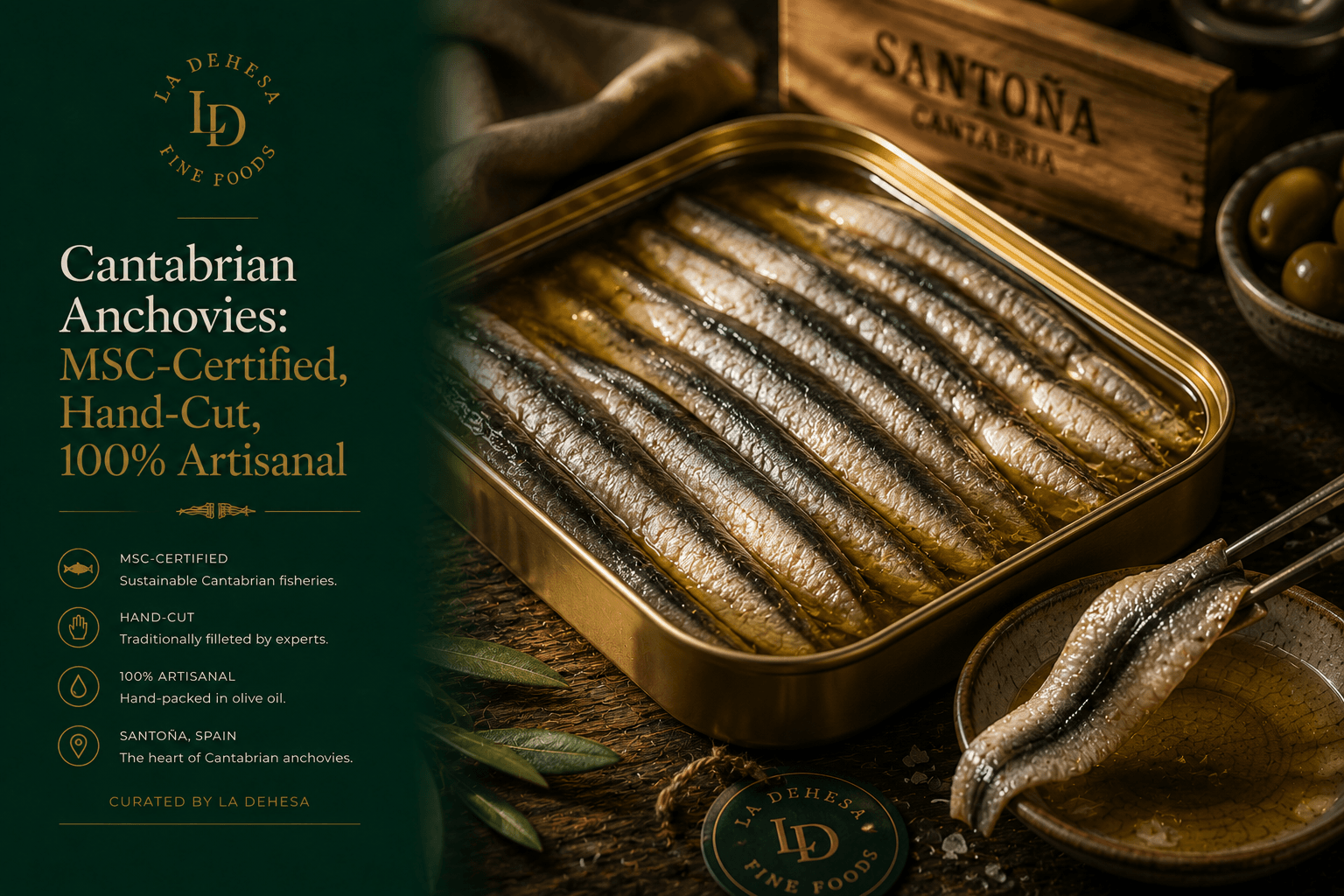
The Renaissance of the Cantabrian Queen: The Santoña Anchovy
By Khristian Rueda · 21 May 2026
In the world of gourmet seafood, few products carry the prestige of the Cantabrian Anchovy. While once a humble staple, it has evolved into a "gastronomic jewel" and the "queen of Spanish preserves," with the town of Santoña standing as its undisputed global epicentre. This industry is a remarkable story of survival, transitioning from a period of environmental concern to becoming a world benchmark for sustainability.
A Heritage of Handcrafted Excellence
The reputation of Santoña anchovies is built on a handcrafted process that has remained largely unchanged since the 19th century. Unlike industrial alternatives, premium anchovies from the Cantabrian Sea (Engraulis encrasicolus) undergo a rigorous artisanal transformation:
The Spring Campaign: The best fish are caught exclusively during the spring fishing season, from April to June, when they are at their peak quality.
The Salt Cure: The fish are aged in saltwater barrels for a minimum of 6 to 12 months to develop their characteristic firm texture and pinkish colour.
Artisanal Filleting: Each anchovy is cleaned, filleted, and packed in olive oil entirely by hand. This meticulous labour ensures the removal of all bones and bitterness.
From Risk to Resilience: The Move Toward MSC
The industry's history is marked by the "delicate equilibrium" of the sea. By the early 2000s, concerns regarding overexploitation were at a peak, forcing the Spanish industry to pivot toward a more resilient and competitive model, placing sustainability as a precondition for anyone wishing to operate in the modern market.
A pivotal part of this recovery has been the adoption of the MSC (Marine Stewardship Council) certification.
What is MSC? An ambitious international programme and ecolabel designed to make seafood markets more environmentally aware. It certifies that fish are caught using sustainable and responsible practices that ensure the long-term health of the species and the marine ecosystem.
A Global Leader: Spanish producers were among the pioneers in obtaining this ecolabel, ensuring that the Cantabrian anchovy is not just a luxury item, but a certified sustainable one.
How to Identify a True Santoña Anchovy
Because not all preserves are created equal, the industry relies on complete traceability and clear labelling to protect consumers from industrial imitations. To ensure you are purchasing a genuine Santoña masterpiece, look for these quality signals on the label:
Exact Species: It must state Engraulis encrasicolus.
Specific Origin: Look for "Cantabrian" or "Santoña" rather than generic "Product of the EU".
The Medium: Premium anchovies are always packed in olive oil or extra virgin olive oil, never generic vegetable oil.
Storage Requirements: High-quality anchovies are semi-preserves, pasteurised rather than sterilised, and must be kept refrigerated between 2°C and 8°C.
Today, the Santoña anchovy industry stands as a model for how tradition and innovation can coexist. By embracing rigorous sustainability standards, this Kingdom of the Anchovy has ensured that its most famous resident will continue to delight palates for generations to come.
Trade Enquiries
Get the La Dehesa brochure
Tell us your venue type and receive the current product range.
Browse the full range of Origin Verified Spanish products on the products page, or learn about our sourcing approach on the about page. Find out why Irish hospitality partners choose La Dehesa on why us.
Interested in listing these products at your venue?