
By Khristian Rueda · 15 May 2026
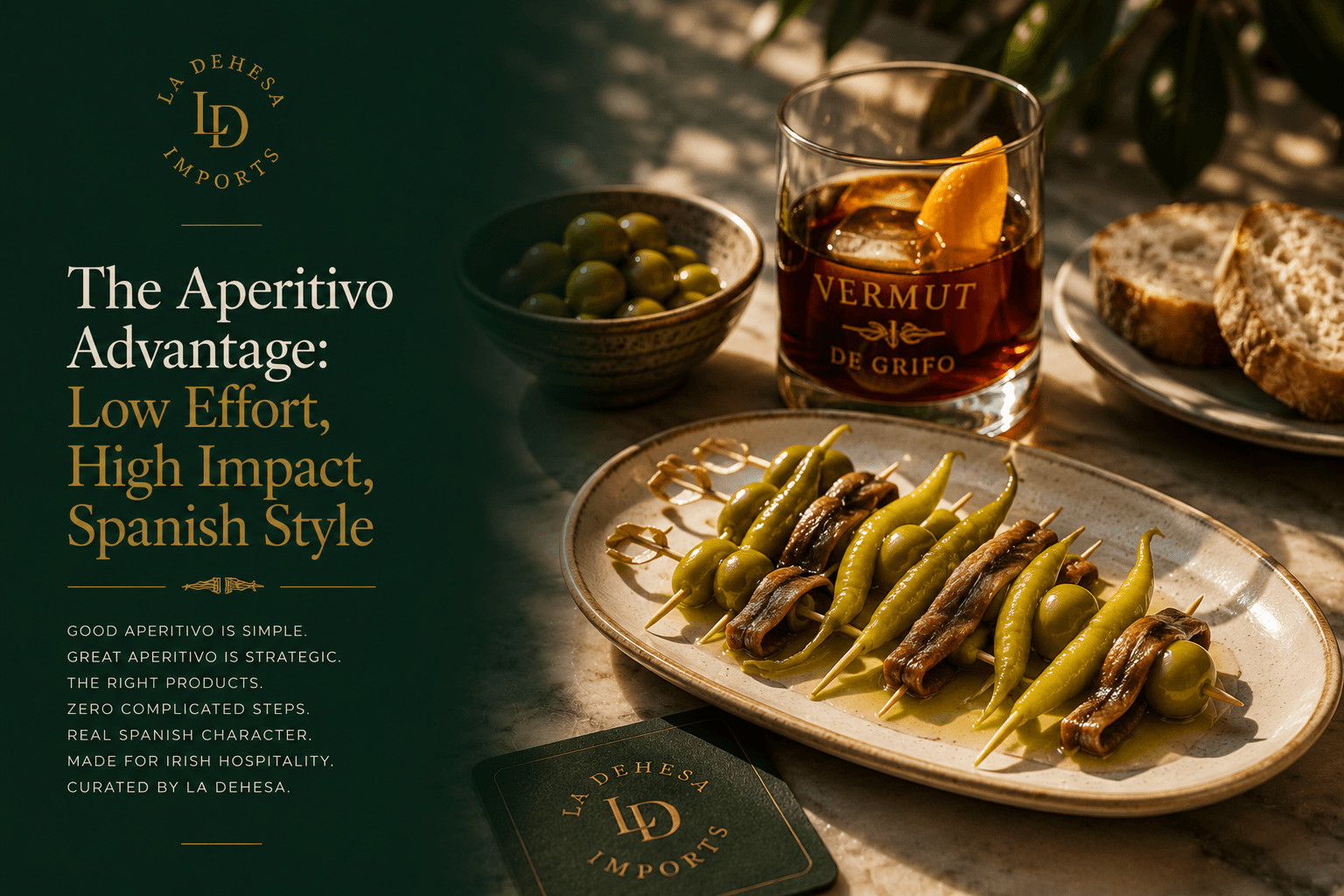
A good aperitivo programme is one of the easiest ways to make a venue feel sharper without adding labour. For Irish bars, restaurants, and delis, that matters. The products have to work quickly, look good on the table, and give the team a simple story to tell. La Dehesa curates the Spanish aperitivo range as a trade tool: low effort, high visual impact, and enough regional depth to make the offer feel deliberate rather than assembled.
Spanish aperitivo: the context
Spain built a social rhythm around the moments before a meal. The aperitivo is not just a snack. It is a small pattern of salt, acid, fat, and drink that gets the appetite moving and sets the tone for the room. Anchovies, olives, gildas, conservas, peppers, and pickles all belong to that logic. They are designed to be opened, plated, and served without any heavy kitchen work.
That simplicity is exactly why the format travels well into Ireland. The venue does not need a separate prep station to make the idea work. It needs a clear assortment, good service discipline, and products that already understand the job they are meant to do. The range should make drinks feel more complete, not more complicated. If the buyer gets that right, aperitivo becomes a repeatable part of the service rhythm rather than a temporary trend.
The regional context also matters because the ingredients are not random pantry fillers. They come from a food culture that understands how to balance brine and brightness against vermouth, wine, cheese, and cured meat. That makes the category especially useful for Irish trade buyers who want a premium food moment that can be explained in one line by the floor team and repeated all week without friction.
The producers and the range
The strongest aperitivo range is built from producers who know how to package flavour for service. Anchovies need a clean cure and precise oil. Gildas need ingredients that hold their shape and bite. Conservas need a marine or vegetable profile that stays vivid once the tin is opened. Olives and pickles need seasoning that supports the drink rather than fighting it. The discipline is in consistency, not excess.
La Dehesa curates combinations that make sense together and that can survive a busy service environment. That means products that store well, plate quickly, and still feel premium when they reach the table. It also means choosing formats that make staff training simple. A good aperitivo item should be easy to explain and even easier to repeat. If a product needs a long speech, it is probably the wrong product for the programme.
The Operational Argument for Aperitivo
The commercial logic is strong. Aperitivo items create an add-on order before the main course, a shared plate with drinks, or a deli counter purchase that feels small but premium. Because the labour is low, the venue can use the range to increase pace rather than slow it down. That is useful for bars and casual restaurants that want a better food offer without building a heavy prep system or adding strain to the kitchen.
It also gives the floor team something easy to sell. The product does not have to be explained as a technical dish. It just needs to be clearly positioned as the thing to order with a drink. Guests understand the format quickly because it feels generous, sociable, and controlled. For Irish buyers, that combination is valuable: easy to execute, easy to explain, and strong enough to make the venue look more considered.
How Aperitivo Fits Bar Service
In Ireland, aperitivo works best when it is built around the real pace of the room. A bar needs items that can leave the fridge and hit the table within minutes. A restaurant needs a pre-dinner snack or a small plate that does not interrupt the kitchen flow. A deli needs products that sell visually and still make sense once taken home. The range should be designed around those use cases, not around a mood board.
That is why the buyer should think in systems rather than individual products. One strong anchovy, one or two conserved seafood lines, a gilda, and a few accompaniments can carry a lot of service weight. If the team knows what belongs together, the programme becomes easier to repeat. If the team has to improvise every night, the category loses its edge. La Dehesa is there to keep that system coherent.
What to look for
Look for clean oil, intact packaging, sensible portion sizes, and products that make sense together. The best aperitivo range should feel like a system, not a pile of random snacks. Buy for service rhythm, not novelty. If an item needs a long speech to sell, it is probably the wrong item. If it can be explained in one line and plated in seconds, it is doing the job.
The buying habit to build is simple: choose products that help the venue move faster and look sharper at the same time. That is what turns aperitivo from a concept into a reliable part of the offer. La Dehesa acts as the access point so Irish buyers do not have to stitch the whole range together on their own.
Final trade note
The best aperitivo offer is the one that the team can run without thinking twice. If the venue has to build a mini project every time a guest orders a snack with drinks, the range is too complicated. If the product can be opened, plated, and sent in one smooth motion, the category starts paying for itself because it supports speed, confidence, and a better guest mood.
Irish buyers should also think about the drinks list at the same time as the food list. The right aperitivo items make vermouth, wine, and even a simple soft-drink service feel more complete. That is the real advantage. The product is doing more than filling a gap. It is creating a reason to order earlier and spend a little longer at the table.
- Keep the range service-led.
- Match each product to a drink.
- Use La Dehesa as the single sourcing point so the system stays coherent.
Related reading
La Dehesa supplies Spanish aperitivo products directly to Irish restaurants and retailers. Request a sample or wholesale price list: hello@ladehesa.com
Trade Enquiries
Get the La Dehesa brochure
Tell us your venue type and receive the current product range.
Browse the full range of Origin Verified Spanish products on the products page, or learn about our sourcing approach on the about page. Find out why Irish hospitality partners choose La Dehesa on why us.
Interested in listing these products at your venue?