By Khristian Rueda · 21 May 2026
Caviar is only useful to a fine dining buyer if it behaves properly in service. That means clean flavour, stable texture, and a story that supports the price positioning of the dish without turning the ingredient into theatre. Spanish aquaculture has become relevant here because it offers a controlled, sustainable path into a category that used to rely on scarcity alone. La Dehesa curates that path for Irish buyers who want a caviar that earns its place on the menu.
Spanish caviar: the context
The modern caviar story is inseparable from aquaculture. Wild sturgeon stocks collapsed under pressure, and the luxury category had to rebuild itself around farming, water quality, and patient maturation. Spain is part of that shift. The country has the climate, infrastructure, and food culture to support a serious caviar trade, especially where clean water, low stress, and careful handling are built into the production system. That is what makes Spanish caviar relevant to chefs who care about ethics as much as service.
Good caviar is not defined only by glamour. It is defined by the balance between salt, brine, firmness, and flavour length. The eggs should feel distinct, not mushy. The finish should be marine and elegant rather than blunt. If the farm, the processor, and the cold chain are disciplined, the result is a luxury ingredient that can sit at the centre of a tasting menu or as a precise supplement on an à la carte dish.
For Irish buyers, that matters because the category has to justify itself on the pass. Caviar is not simply there to signal spend. It has to support the kitchen's style, the bar's pairing logic, and the guest's sense that the dish has been thought through. Spanish aquaculture gives La Dehesa a way to present that logic in English, with a focus on process rather than hype.
The producers
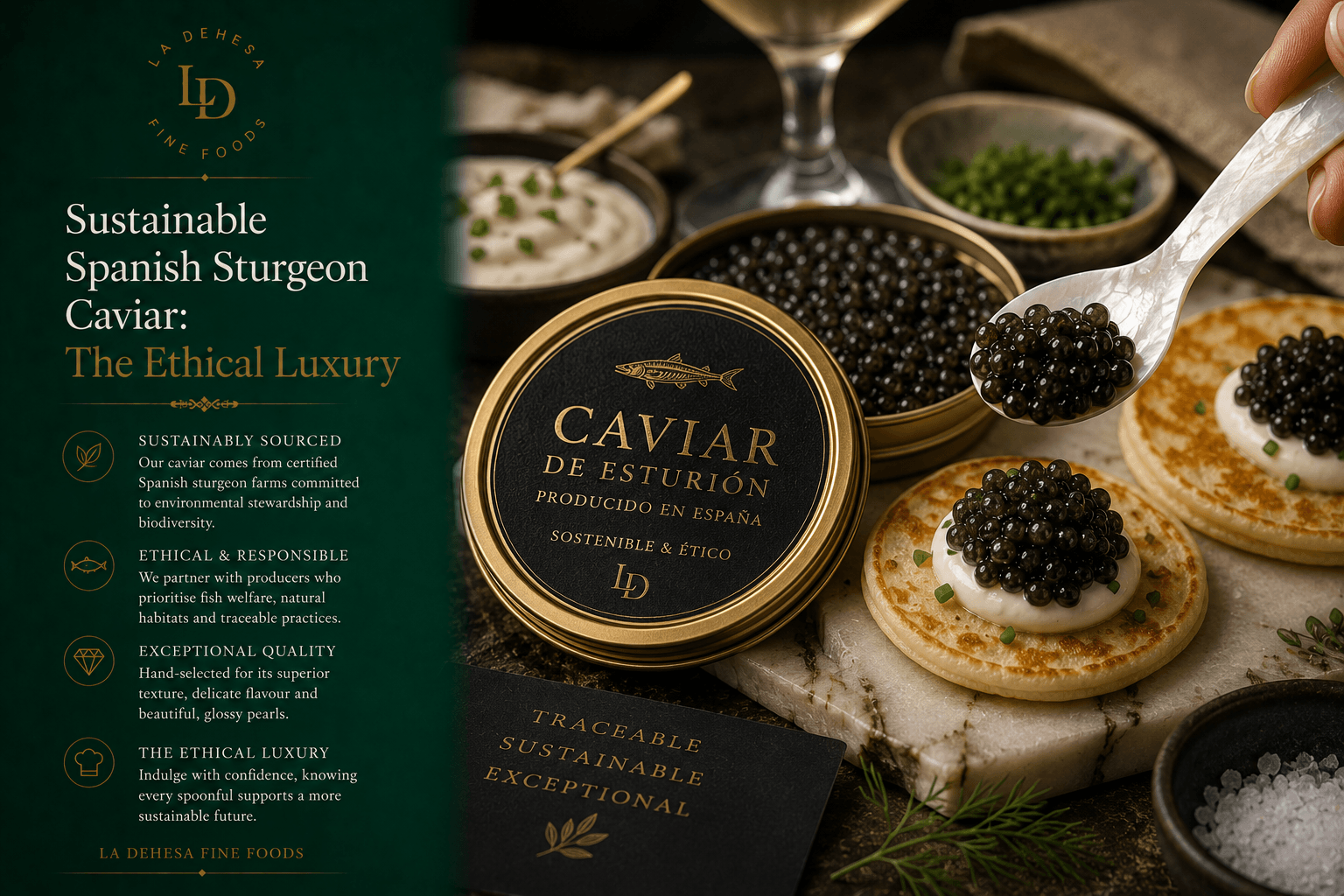
Specialist caviar producers work with sturgeon over long cycles. They monitor water conditions, manage feed carefully, and harvest with enough discipline to protect both quality and welfare. That patience is what separates premium caviar from a commodity approach. sustainable Spanish caviar is one of the names buyers should know because it represents the kind of specialist focus that turns aquaculture into a luxury category rather than an industrial one.
We source caviar from producers who are serious about maturation, grading, and consistency. The tin has to travel well, the eggs have to hold their shape, and the flavour has to be clean enough to pair with shellfish, potato, egg, or a simple blini service. La Dehesa does not curate caviar as a status symbol. We curate it because the right producer makes the product reliable enough for trade.
The Commercial Case for Spanish Caviar
Spanish caviar works when the kitchen wants a luxury signal that can be repeated. It gives a tasting menu a moment of precision without forcing the whole plate to become ornate. It can be used as a small garnish, a supplement on a premium dish, or a pairing element beside a drink programme. The reason it remains attractive to trade buyers is simple: it creates immediate perception of care, but it also behaves like a serious ingredient.
There is a commercial case as well, even if buyers should never reduce the category to numbers. Caviar can support premium positioning when the venue understands how to serve it. The ingredient asks for calm, not clutter. It performs best when the menu language is precise and the service is disciplined. Irish restaurants that already value provenance, seafood, and restrained luxury are the natural home for it.
What to look for
Check species, grading, tin integrity, salt balance, and freshness. Good caviar should be stored cold and opened only when needed. The eggs should feel distinct and have a clean pop rather than a wet collapse. If the flavour is too aggressive, the salt or processing has taken over. If it tastes flat, the cold chain or the maturation has failed. These are small signals, but they matter because the category has little room for error.
Buy from a curator who understands how the tin will be used. A fine dining menu does not need every caviar on the market. It needs the right one, in the right format, from a producer that can deliver consistency. That is the role La Dehesa plays for Irish buyers.
What Matters on the Spec Sheet
Caviar should be bought with service in mind, not excitement alone. The best tin is the one that can be opened confidently by a chef who knows exactly how it will land on the plate. That means the texture has to stay intact, the salt has to be balanced, and the finish has to be clean enough to sit beside rich ingredients without being flattened by them.
The menu question is about restraint. A small amount of the right caviar can improve a dish more than a large amount of the wrong one. That is why Spanish aquaculture matters. It gives buyers a more reliable route into the category, with a product that behaves properly and a producer story that supports the idea of sustainable luxury rather than empty theatre.
When you brief the team, keep the language simple. The caviar should be described as precise, premium, and clean. Guests do not need a lecture. They need confidence that the kitchen has chosen the right ingredient for the right dish. La Dehesa acts as the buyer's filter so that confidence is easier to build.
- Check the salt level, egg size, and cold-chain handling before listing.
- Use caviar where a small amount changes the whole dish.
- Keep the menu language calm and specific rather than dramatic.
Buyer close
Caviar is at its strongest when the kitchen treats it as a precise finishing move. The right tin changes the dish without demanding attention from the guest. That is why sustainable Spanish aquaculture is such a useful route into the category: it makes the product easier to trust, easier to repeat, and easier to position.
La Dehesa keeps the producer story in the foreground because the buyer should know why the caviar is worth listing. Once that is clear, the ingredient can do its job quietly and properly.
- Buy for balance, not just luxury cues.
- Keep the service calm and disciplined.
- Let the dish carry the caviar, not the other way around.
Related reading
- /blog/sustainable Spanish caviar-sustainable-luxury
La Dehesa supplies Spanish caviar directly to Irish restaurants and retailers. Request a sample or wholesale price list: hello@ladehesa.com
Trade Enquiries
Get the La Dehesa brochure
Tell us your venue type and receive the current product range.
Browse the full range of Origin Verified Spanish products on the products page, or learn about our sourcing approach on the about page. Find out why Irish hospitality partners choose La Dehesa on why us.
Interested in listing these products at your venue?